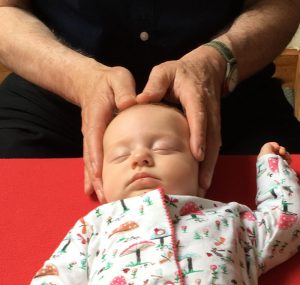
Craniosacral Therapy helps give a baby a great start in life. It can be helpful for any baby and particularly if your baby is not feeding well, has colic, reflux, is not sleeping or is just clearly in discomfort or not happy. Cranial work is such a gentle, safe and effective way to help them move towards more comfort and ease.
Parents know if their child is happy and comfortable. When a baby cries, it is always for a reason. When medical reasons have been ruled out this is when Craniosacral Therapy for babies is often a good avenue to explore.
Birth
Whilst the baby’s body is well designed to manage the range of compressive forces of a natural birth, stronger compressive forces can be harder for the baby’s body to recover from. This can include very long births, very short births, babies getting stuck or necessary medical interventions including the use of forceps, ventouse cups and caesarian section. All of these may affect the baby’s body, putting strain or compressions on body tissues.
Late Pregnancy
In the last few weeks of pregnancy space in the womb is limited and baby’s movement is constrained. Baby will lie, curved more to one side and this tendency over a period of days or weeks tends to cause compression of the tissues on that side of the body. This is seen in the baby favouring turning to one side rather than the other after bith and can lead to ongoing uneven development.
Recovery
For these reasons, babies may come into the world in a less than ideal state. Our bodies have a remarkable ability to heal and normalise. Where that is not fully possible on its own babies will exhibit signs of discomfort and distress. Craniosacral Therapy works to help the baby complete the process of recovery from birth and develop to its full potential.
Babies generally need only a small number of sessions as their bodies express vitality more fully than in an adult.
Baby Conditions
Conditions which affect babies that I see on a regular basis are discussed below:
General discomfort
Babies cry for a reason.
If a baby is uncomfortable they will cry. When medical conditions have been ruled out, then it may be that they are still experiencing after-effects of birth or time in the womb. Things that can affect babies in birth are; a long labour, a very short labour or the necessary medical intervention of forceps, ventouse cup or caesarian section. Babies may already be quite compressed from the last few weeks in the womb as there is then very little space and the baby is often lying in one position and so can get compression their bodies from that. In both these situations cranial work helps to reduce the compressions and strains in the baby’s body and nervous system and helps the body expand back into its full state of ease. Once baby is comfortable again this helps bonding between parent and baby.
Infant Colic
Colic affects up to 20% of babies.
It can be very upsetting to both baby and parents. I recommend a dual approach to managing colic; having cranial work and looking at the baby’s diet. Cranial work. A study called A preliminary assessment of the impact of cranial osteopathy for the relief of infantile colic showed a marked reduction (40%) in crying and 9% increase in sleep between the treated and untreated babies. Cranial work for colic comprises general work to reduce any discomfort the baby may be experiencing and giving specific attention to the nerves that govern the digestive system.
Baby’s diet The links below give a good coverage of diet and other aspects of colic.
This article in the British Medical Journal on the Management of Infantile Colic mentions cranial work under Chiropractic. It should be noted that the possible negative effect mentioned there would not occur with a cranial approach, since we are not using any force on the baby’s body.
It occurs when acid from the stomach comes up into the oesophagus causing pain. This may be evident in spitting up milk, or it may be silent, where there is no evidence of milk coming up. The circular muscle (sphincter) that keeps the top of the stomach closed is not doing its job completely. This may be because the diaphragm which surrounds the sphincter is holding tensions and this may be because the rib cage is also not at ease and balanced. Cranial work will evaluate and help release any tensions in the chest and diaphragm in order to allow the diaphragm to support the sphincter to do its job of retaining the content of the stomach.
Head tilting to one side – torticollis
This is commonly due to shortening of muscles on one side of the neck.
It can lead to a flattening of the head on one side – see below. Cranial work will give attention to how this shortening is occurring and help the body to re-lengthen and self-correct.
Flattened head (plagiocephaly and brachycephaly)
An increasing number of babies have flattened heads.
Here is a useful summary page from the NHS and a similar page from Great Ormond Street Hospital for Children. The paper Palpatory diagnosis of plagiocephaly finds correlations between the incidence of flat heads and birth procedures. Cranial work helps take strains out of the base of the head and helps release restrictions that impede the inherent movement between the bones in the head and therefore helps the body to normalise its own structure.
Sleep disturbance
Disturbed sleep can happen for many reasons.
When medical conditions have been eliminated, Craniosacral Therapy can help to address any of the other issues that may be causing it, some of which are discussed above.